Networking, Technology, Commands, Social Media, Wireless Home,Local area Networks
The Network Effects Manual: 13 Different Network Effects (and counting)
Get link
Facebook
X
Pinterest
Email
Other Apps
-
Zeeshan Mir Baz has collected the information from this website:https://medium.com/@nfx/the-network-effects-manual-13-different-network-effects-and-counting-a3e07b23017d in this article
Our three-year study, which we released recently, shows that nfx are responsible for 70% of the value created by tech companies
since the Internet became a thing in 1994. Even though they are only a
minority of companies, companies with nfx end up creating the lion’s
share of the value.
For Founders looking to build truly impactful companies, few areas of expertise are more valuable.
Still,
because very little has been written about nfx, misconceptions abound.
Many people talk about them, but few understand the hidden complexities:
what they really are, how they work, the many different types, and how
to build and maintain them. Moreover, very few companies want to share
their valuable playbooks around nfx, so most founders don’t even
recognize different types of nfx when they see them, much less
understand their complex inner workings.
Today
we are pleased to present the Network Effects Map and accompanying
manual for the first time. It’s an ever-evolving effort, and we’re
continually making changes and updates. As of early 2018, we’ve
identified 13 types, each with their own complex playbook. This manual
is a starting point for discussion around nfx, and for understanding
those playbooks.
Nfx basics
As
you probably know, the simplified definition of network effects is that
they occur when a company’s product or service becomes more valuable as
usage increases.
By
this definition, network effects seem deceptively straightforward. But
when you take a closer look, you start to notice that different types of
networks are very different in how they behave. As a result, not all
nfx are created equal — some are stronger and tend to produce more value
than others.
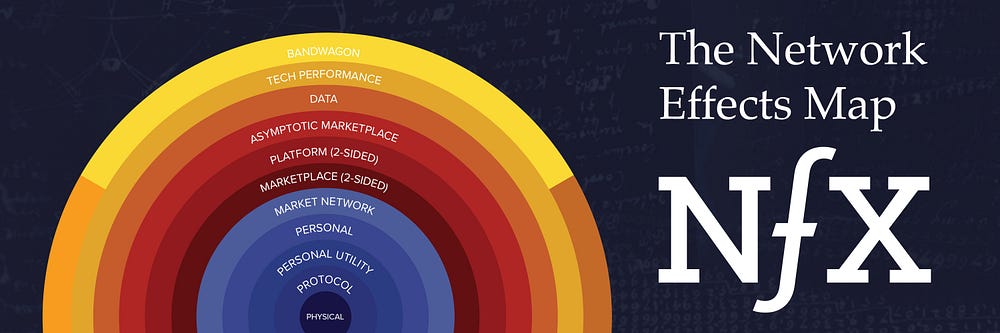
Network effects are one of the four remaining defensibilities in the digital age, including brand, embedding, and scale. Of the four, network effects are by far the strongest. To date, we’ve identified 13 distinct types of nfx that fall under five broader categories.
In
the map below, we’ve depicted the various nfx types (labeled) and
categories (organized by color), with the strongest and simplest network
effects at the center of the map. The other three defensibilities are
also shown on the right.
We
developed this map as an exercise over the years to help bring greater
clarity to the subject. But before we dive in, there are a few things we
should point out:
The
map we’ve laid out here isn’t meant to be taken as an incontrovertible
truth — it’s a beginning point for discussion and understanding. It’s
one of our evolving methods to help Founders recognize and make use of
powerful forces to build great companies. Because for Founders looking
to build a strong competitive moat, the ability to identify and
understand nfx is invaluable.
Network effects are not
viral effects. Network effects are about creating defensibility, and
viral effects are about getting new users for free. They have totally
different objectives and playbooks.
You’ll
often see the same companies have several nfx at play simultaneously,
meaning that the different nfx types are not mutually exclusive. They
are like colors, and your company is like a work of art. It helps to be
familiar with the full palette as you paint.
With
that said, let’s turn to the Map itself. Below each of the various nfx
on the Network Effects Map are described, with relevant examples.
Direct Network Effects
The
1st broad category of nfx, shown in blue on the Network Effects Map,
are direct network effects. The strongest, simplest network effects are
direct: increased usage of a product leads to a direct increase in the
value of that product to its users.
The
direct network effect was the first ever to be noticed, back in 1908.
The Chairman of AT&T at the time, Theodore Vail, noticed how hard it
was for other phone companies to compete with AT&T once they had
more customers in a given locale. He pointed this out in his annual report to shareholders, writing that:
“Two
exchange systems in the same community, cannot be… a permanency. No one
has use for two telephone connections if he can reach all with whom he
desires connection through one.”
Vail
noticed that the value of AT&T was mostly based on their network,
not their phone technology. At the time, it was a revolutionary insight.
It showed that even if a new telephone was clearly superior to their
old phone on a technical level, no one would want the new telephone if
they couldn’t use it to call their friends and family.
In
other words, a better product wouldn’t come close to making up the lost
value of the network. A new entrant would have to achieve a comparable
network effect to realistically produce a comparable amount of value for
its users. In Vail’s words:
“A
telephone — without a connection at the other end of the line — is not
even a toy or a scientific instrument. It is one of the most useless
things in the world. Its value depends on the connection with the other
telephone — and increases with the number of connections.”
Below
are the full texts of the relevant pages of that 1908 annual report.
You’ll notice that Vail never uses the phrase “network effects”,
although that’s the concept he’s describing. The term itself would only
emerge later.
Excerpts from the AT&T 1908 Annual Report
72
years after Vail first described direct network effects, the father of
the Ethernet standard, Robert Metcalfe, took the concept a step further
by proposing that the value of a network is proportional to the number
of connected users squared (N2). This is now known as Metcalfe’s Law.
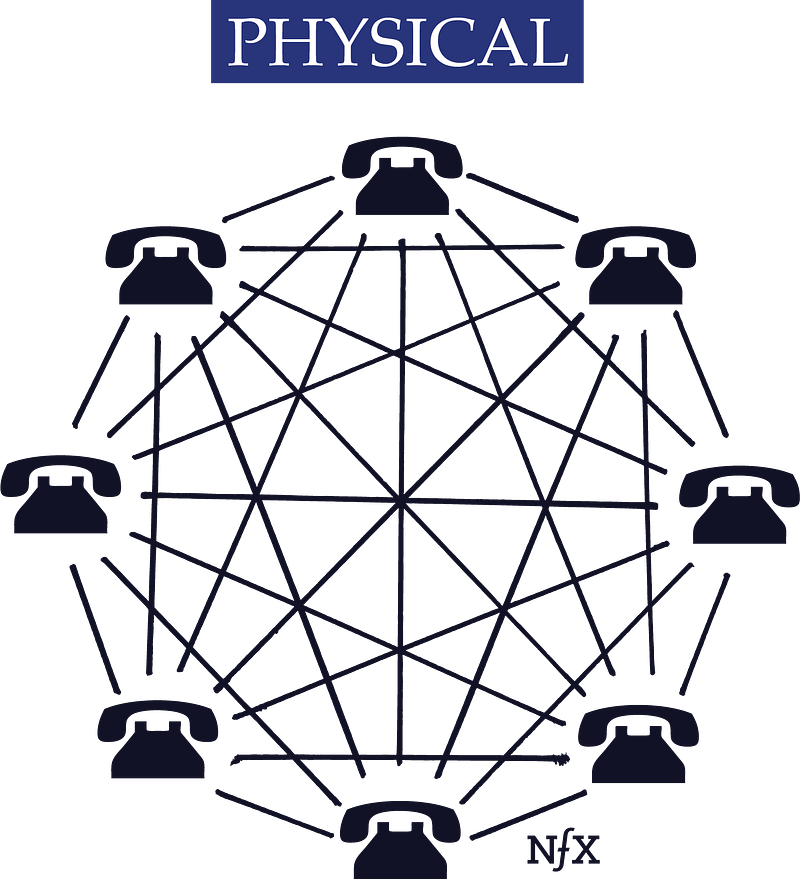
The diagram below illustrates the basic concept of a direct network as described by Metcalfe’s Law:
Each
node in a digital network is connected to every other node, as
represented by the diagram above. Every additional node that joins a
direct network adds a new connection for all the existing nodes, so the
number of new connections (network density) increases as a square of the
number of nodes (N2). Since the value of a network is proportional to
its density, each additional node adds to the network value at a
geometric rate.
In 2001, an MIT computer scientist named David Reed went even further, declaring that Metcalfe’s law actually understated the
value of a network. He pointed out that within a larger network,
smaller, tighter networks can form: for example, the football team
within a high school network; siblings within a family network; tennis
players within a co-worker network.
Such
connections, and the potential to join other subgroups, cement people’s
commitment to the overall network in deeper ways that the overall size
and connection density of the network would imply by themselves. Because
of this, Reed believed that the true value of a network increases
exponentially (2^N) in proportion to the number of users, much faster
even than what Metcalfe’s Law described. We now call this Reed’s Law.
The
details of these laws can be debated academically, but for Founders,
they provide a tangible way to conceptualize an operational truism — nfx
are powerful. They are a law of nature.
Within
the broader category of direct nfx, there are many different types. So
far, we’ve identified five: physical, protocol, personal utility,
personal, and market network.
Physical (Direct)
Physical
Direct nfx are direct network effects tied to physical nodes (e.g.
telephones or cable boxes) and physical links (e.g. wires in the
ground). This is the most defensible network effect type because it not
only has a direct network effect, but it also lends itself to the
addition of other defensibilities; namely, scale effects and embedding.
Competing with a company that has Physical Network Effects requires a
large upfront investment of capital and physical constraints.
The
diagram above depicts the shape of a physical network, with the nodes
representing utility terminals like landline phones, train stations, or
water faucets, and the connections between nodes representing physical
infrastructure like landlines, train tracks, or water pipes.
Roads,
trains, electricity, sewage, natural gas, cable and broadband internet
are examples of businesses with physical direct network effects. In
fact, most Physical Networks are utilities: winner-take-all markets that
develop into monopolies and end up being nationalized.
The
best evidence for the strong defensibility of Physical Networks is that
so many of them have poor or substandard services, and yet continue to
lead the market. Think of Comcast and Verizon. Why do they have the lowest customer satisfaction
in the US? Because they can get away with it at no risk to their bottom
line. No one can compete with them. Who could spend the money to lay
all that cable? And with no competitors, frustrated customers have
nowhere to turn.
Protocol (Direct)
A
Protocol Network Effect arises when a communications or computational
standard is declared and all nodes and node creators can plug into the
network using that protocol. Bitcoin and Ethereum are recent examples of
protocol networks. The protocol setter can be either an individual
company, a group of companies, or a panel.
Protocol
networks coalesce around communication and computational standards,
which form the basis for the links between nodes (e.g. Bitcoin miners
and Bitcoin wallets).
Ethernet
is another, more traditional, example of a Protocol Network Effect.
When Robert Metcalfe founded 3Com, he persuaded DEC, Intel, and Xerox to
adopt Ethernet as a standard protocol for local computer networks, with
a standard speed of 10 megabits per second, 48-bit addresses, and a
global 16-bit Ethertype-type field. Competing proprietary protocols
existed, but as Ethernet pulled away and began to capture more and more
market share, Ethernet-compatible products flooded the market. This
increased the value of Ethernet at a compounding rate and decreased the
value of competitors, regardless of their relative performance. Soon,
ethernet ports became standard features of all modern computers.
Once
a protocol has been adopted it is extremely difficult to replace. Note
how the fax protocol is still in use, or the TCP/IP protocol (even
though other, better protocols now exist for those purposes).
It’s
also true that the protocol creator doesn’t typically capture most of
the value from the development of the network, as they normally do with
other direct nfx.
This
distribution of value in a Protocol Network can be shifted if the
protocol creator can maintain ownership of a significant percentage of
the tokens within a token-enabled network, or maintain central control
over addressing, identity, wallets, naming, or prioritization and still
get the network to adopt the protocol.
The
success of such an adoption strategy is often less about technology and
more about marketing, social engineering, and choice of market niche.
That’s why VHS beat Betamax, even though Betamax was arguably a better
standard. It’s also part of why Bitcoin has taken off as a virtual store
of value, when it is more costly to operate and no more useful than
many other virtual currencies that preceded it.
Personal Utility (Direct)
Personal
Utility Networks have two distinguishing qualities. The first is that
users’ personal identities are tied to the network in question, often
with usernames tied to their real name as with Facebook Messenger. The
second is that they are essential to the personal or professional lives
of users on a daily basis.
In
the diagram above, the nodes are represented by the chat bubbles of
people (nodes) connected by personal utility services (links). The nodes
of a personal utility network are tied to the real-life identity of the
people using it, and the network is especially dense because it has
many local sub-groupings. This brings Reed’s Law into effect, so the
value of Personal Utility Networks could increase at a rate of up
to 2^N.
People
use Personal Utility Networks to communicate and interact with their
own personal networks, so not being online or being part of the network
has a steep downside. Opting out would become a significant impediment
in daily life and could greatly harm people’s important personal or work
relationships.
Personal (Direct)
Personal
nfx are in play when a person’s identity or reputation is tied to a
product. Often people on a Personal Network are influenced to join by
people they might know in real life. If people you know from the real
world are all using the same product to house their identity and
reputation, there’s a large value add (to you) if you join the network
yourself.
Personal
Networks involve personal identity and reputation, connecting the
persona of each user with other user personas. Each additional node
represents both an additional potential audience member as well as an
additional content producer for all the other nodes.
Personal
Networks differ from Personal Utility Networks in two main ways. As
explained in the previous section, Personal Utility Networks are
typically used for things that need to get done. There is a substantial
amount of practical utility to
the user. Second, Personal Utility Networks are typically more for
private communication, rather than public communication. Personal
Networks are less vital. You can stop using them and your life won’t
alter that much. Networks like Facebook or Twitter or Linkedin (when
you’re not job hunting) aren’t usually essential for your day-to-day
life.
However,
Personal Networks are still very strong. You aren’t running to join
another friend network or professional network now that you have FB and
LinkedIn. It’s also true you could stop using both and be fine on a
daily basis.
There’s
a difference between sending an IM to your significant other telling
them to not miss picking up your Mom at the airport and posting a status
update about your Mom visiting on social media. In both cases, your own
identity is tied to the communication and your audience is your
personal connections. But one is a private need-to-have and the other is
a public nice-to-have.
The
Personal Network Effect arises from the interpersonal, tribal impulse
to build connections with others. It’s this impulse that compels people
to join and stick with a network (e.g. Facebook, LinkedIn, or a
religion) because their friends/co-workers/neighbors are also part of
that network. A user’s “social graph” in a personal network are usually
closely mapped to their in-the-flesh relationships.
Market Networks (Direct)
A
Market Network combines the identity and communication aspects of a
Personal Network with the transactions focus and purpose that typify a
marketplace. Usually, Market Networks start by enhancing a network of
professionals that already exists offline. We consider Market Networks
to be a form of direct network effects because the relationship between
nodes is direct, as shown below:
Market
Networks are very different from 2-Sided Marketplaces, although the two
are often confused. Most people think companies like HoneyBook and
Houzz are marketplaces, but they’re not. In reality, they’re Market
Networks, which combine the main elements of both Personal Direct
Networks and 2-Sided Marketplaces, as well as being many-sided
as opposed to 2-sided — often with the addition of a dedicated SaaS
workflow software. For a detailed description of Market Networks, see our article on the subject.
2-Sided Network Effects
The
2nd broad category of nfx, 2-sided nfx, are often called “indirect
network effects” in academic literature. However, we think this is
misleading since 2-sided networks can involve both direct and indirect network effects.
Instead,
the real distinguishing characteristic of a 2-sided network is that
there are two different classes of users: supply-side and demand-side
users. They each come to the network for different reasons, and they
produce complementary value for the other side.
It’s
relatively simple to see how each new supply-side user in a 2-sided
network directly increases the value of the network for demand-side
users, and vice versa. For instance, each new seller (supply-side user)
on a 2-sided marketplace like eBay directly adds value for buyers
(demand-side users) by increasing the supply and variety of goods.
Likewise, every additional buyer is a new potential customer for
sellers.
It’s more complicated when we look at how same-side users interact. Most of the time, users on the same side subtract
value directly from each other. For instance, core sellers on eBay
create more competition for other sellers. More Uber passengers at rush
hour mean surge pricing. Both are examples of negative direct same-side
nfx.
At the same time, indirect
benefits usually end up outweighing those direct negatives. The fact
that there are many sellers in the marketplace attracts the buyers to be
there in the first place. And that is ultimately more valuable for the
sellers, even if they have to sell at more efficient prices. The same is
typically true on the buyer side.
This
positive indirect effect of 2-sided networks has been discovered and
rediscovered throughout history. In the late 1600s, for instance, all
the violin makers moved to work and sell their violins on the same
street in Venice. Although the proximity of the competing violin vendors
drove down prices, it was worth it for the suppliers as a group because
it was more important for them that people in the market for violins
would take their business to that particular street, not some other
street in some other city.
In
the 1980s, malls in the US discovered the same thing. By aggregating
competing sellers in one location, sellers were able to get much more
business than others that were spread out, making it practical for
competitors to co-locate.
What
we’re seeing now with the preponderance of online 2-Sided Networks is
the same effect, but with software instead of a physical location.
Note also that there are cases of positivedirect
same-side nfx, where more same-side users add value to each other.
These are very powerful and should be sought out as you design your
products. This is the case with Microsoft OS, one of the most enduring
2-sided nfx products the world has seen. Microsoft OS users benefit
other users because they can share files more easily with co-workers and
friends. This is a positive direct same-side network effect (adding to
the core 2-sided network effect) that is typical of operating systems.
At present, we’ve identified three types of 2-sided network effects: marketplace, platform, and asymptotic.
Marketplace (2-Sided)
The
two sides of a marketplace are buyers and sellers. Successful 2-Sided
Marketplaces like Craigslist are very difficult to disrupt. To break
them apart you must have a better value proposition for both parties simultaneously,
or else nobody moves. Customers are there for the vendors, and vendors
are there for the customers. One won’t leave without the other.
2-Sided
Marketplaces have two sets of nodes, as shown above. One set are
supply-side users, the other are demand-side users. They provide direct
value for each other through the marketplace, which is an intermediary
represented by the central node in the diagram.
With
a 2-Sided Marketplace, the network is what provides the majority of the
value, not the app or website itself — which explains why marketplaces
products like eBay and Craigslist can afford to look essentially
unchanged after 16 years.
But
there’s one big weakness in marketplace defensibility, which arises
from the phenomenon of “multi-tenanting”. People can sell their products
on eBay and Etsy at the same time. Landlords can list their apartments
on Craigslist and Trulia, and renters can check both marketplaces to
browse for inventory. It’s hard to lock out competition from new
entrants when the members of your network can use competing networks as
well as yours without a penalty. The goal of the marketplace is thus to
design the product/service to add so much value or “lock-in”,
particularly on the supply side, that members won’t be tempted to
multi-tenant.
Further,
marketplaces come in more shapes than we might think. Media companies,
for example, are essentially 2-Sided Marketplaces. Audiences (supply)
come to the marketplace and sell their attention for content
experiences. Advertisers (demand) on the other side buy the attention of
the audiences. The greater the audience of a media company, the more
likely advertisers will be to spend any money on that media company at
all, and then the more money they will be willing to pay the company
when they do. “Sellers” i.e. readers/viewers have a direct positive
network effect for “buyers”, i.e. advertisers. And vice versa, because
(in theory) more advertising revenue gives a media company the resources
to produce better content.
Platform (2-Sided)
What
we call 2-Sided Platform nfx are similar to 2-Sided Marketplace nfx, in
that they have two sides with very different interests that directly
benefit each other. The difference is that the supply side actually
engineers products that are only available on the platform. The supply
side has to do work to integrate to the platform. The products created
and sold by the suppliers are a function of the platform, not
independent of it.
2-sided
platforms have supply-side nodes (developers) and demand-side nodes
(users), which create value for each other through the intermediary of
the platform itself (central node). The platform itself also provides
significant value for both sides.
Microsoft
OS, iOS, and Android are prime examples of products that have achieved
this type of nfx. Xbox, PlayStation, and Wii are also examples, although
they’re slightly different.
Another
difference platforms have from marketplace nfx is that, compared to
online marketplaces, the features and benefits of the platform itself
can play a greater role in the utility of a platform relative to the
network. People buy iPhones and thus iOS for the brand, design,
technical features, and performance of the phone as much as they do for
the app ecosystem. People might buy Xbox and PlayStation consoles for
the graphics and performance of the system as much as they do for the
library of available games. This in contrast with marketplaces, where
the product itself comes in at a very distant second compared to the
value of the network.
How
a platform is sold can also matter a great deal to how well adopted it
becomes by both sides. For instance, Microsoft has an army of
salespeople who sell their platform to large corporate clients, and they
often give the platform away for free to universities so graduates
learn to standardize on that platform.
One
vulnerable point for platforms is that, just like with marketplaces,
both sides of platforms can also multi-tenant. App developers can create
versions of their app for both iOS and Android. Game developers can
syndicate their games to PlayStation as well as Xbox. Likewise with the
other side — gamers can own a PS4 and an Xbox One simultaneously, and
people can own both a Dell and a Macbook. However, the pricing makes
this more prohibitive than with online marketplaces, where
multi-tenanting is usually free. So from that standpoint, platforms
often have a leg up.
Asymptotic Marketplace (2-Sided)
Of
course, no two 2-Sided Marketplaces are exactly the same. One way they
can significantly differ is in the “value curve.” This refers to how fast the value to the demand side increases as supply increases, and how strong the nfx get when critical mass is reached.
The “Value Curve” diagram below illustrates the supply and demand curves for three subcategories of marketplace nfx..
The
straight line (orange) in the middle is what you would expect with
Craigslist or eBay, where generally, the growth of the supply side
produces value to the demand-side at a relatively proportional rate.
Marketplaces like this get very strong over time.
The “Value Curve” diagram illustrates it below.
The
lower curve (yellow) is what you saw with OpenTable, where the value is
delayed. OpenTable had to grow the supply-side of restaurants to a very
high level before there was any value to the demand-side. Once that
critical mass was achieved, however, the network effect became very
powerful.
The
third subcategory of marketplace nfx, illustrated by the red curve on
the graph above, is what we call Asymptotic Marketplace nfx. It has the
inverse properties of OpenTable’s delayed value curve. The initial
supply quickly adds value to the demand side, but soon the value of
increased supply starts to diminish.
The most famous examples of an Asymptotic Marketplace are ridesharing companies like Uber and Lyft, as we wrote about in this Uber case study.
Up to a point, more drivers benefit riders because of reduced wait
times. But beyond a certain point, the value to the rider steeply
diminishes. Waiting 4 minutes for a ride as opposed to 8 minutes is a
huge difference. But 2 minutes instead of 4 minutes? The value of
increased supply diminishes drastically around the 4-minute mark.
Asymptotic
Marketplaces are more vulnerable to competition than other marketplaces
for this reason. If Uber has 1000 drivers in a certain area, a
competitor might be able to provide comparable service with half as
many.
Adding
to this vulnerability, Asymptotic Marketplaces can be very susceptible
to multi-tenanting. Many people use both Lyft and Uber to get around,
depending on which one has lower pricing and faster waits at any given
time. On the supply side, many drivers use both Uber and Lyft, depending
on pricing and wait times.
Data Network Effects
When
a product’s value increases with more data, and when additional usage
of that product yields data, then you have a Data Network Effect. This
is the 3rd broad category of nfx.
With
a data network, each node (user) feeds useful data to the central
database. As the aggregated data accretes, the value of the data for
each user also grows.
Data
nfx tend to be weaker than many people — particularly venture
capitalists — often want to believe: having more data doesn’t
necessarily translate to value, and gathering more useful data isn’t
always easy even if data is central to the product.
Data
can increase product value in different ways. If data is really central
to the way the product benefits users, then the data nfx of that
product has the potential to be very powerful. If data is only marginal
to the product, the Data nfx won’t matter much. When Netflix recommends a
show to you, the algorithm is basing that recommendation on user
viewing data. But Netflix’s discovery function is marginal; its real
value comes from the inventory of tv shows, movies and documentaries. So
Netflix only has a marginal Data Network Effect.
Likewise, the relationship between product usage and the amount of useful new
data gathered can be asymmetrical. Yelp has a Data Network Effect
because a greater number of reviews for a greater number of restaurants
makes the product more valuable. But its network effect is weakened by
the fact that only a small percentage of users produce the data; most
people read from the Yelp database but don’t write to it.
At
the same time, Yelp is also a good example of a common weakness in Data
nfx. Its Data nfx are asymptotic. The 5th review adds a lot more value
than the 30th. Past a certain low level, more reviews on a restaurant
don’t increase the value to you, the user. (Breadth of reviews, on the
other hand, is very helpful and leads to solid nfx, which is why Yelp is
still so prevalent.)
If
a product has no relationship between increased usage and more useful
data production, then there is no network effect; it’s merely a scale
effect. Credit reporting agencies like Experian have a scale effect
because even though more data makes their credit scores more valuable
(i.e. accurate), usage of the product by consumers doesn’t naturally
increase the amount of data they have.
Data
nfx are easy to confuse with the data advantages that come from scale.
Large companies have more data by definition. The question is, does that
data create meaningful value for customers/users? And if so, does
increased usage lead to more useful data?
A
good example of a service with a strong Data Network Effect is Waze.
Not only does nearly everyone consuming data on Waze also contribute
useful data, but because the data is consumed in real time, the dataset
needs to be continuously updated. So the larger the network, the more
accurate that data will be at any instant for any given road. More data
continues to produce value almost indefinitely, so there’s less of an
asymptotic data nfx with Waze than almost any other service we can think
of.
Data
nfx are possibly the most complicated nfx category. There are as many
different data nfx as there are ways to use data. We’ll be mapping out
data nfx in greater detail in the future.
Tech Performance Network Effects
When the technical performance of a product directly improves
with increased numbers of users, it has Tech Performance nfx. This is
the 4th broad category of nfx. For networks with Tech Performance nfx,
the more devices or users on a network, the better the underlying
technology works. This makes the product/service become faster, cheaper
or easier.
Networks
with tech performance nfx become better (faster, cheaper, or easier to
use) the bigger they get. As more nodes (devices) join the network, the
performance of the whole improves.
Consider
peer-to-peer file sharing services like BitTorrent, or VPN providers
like Hola, or object finding mesh networks like Tile. These services get
faster for all users the more nodes are on the network. Every person
downloading a file from BitTorrent is also seeding files to the network.
The more people who have a Tile app installed, the greater the chances
that you can locate something you lost since every phone on the network
is constantly scanning for tiles. Skype also claims that the more people
using Skype, the better the video streaming quality (it’s not clear if
this true, but it’s the right idea for them to have).
Tech
Performance Network Effects are different from technological advances,
and we would argue they are superior. Technological advantages have a
short half-life and aren’t very defensible anymore. If you’re the first
to come out with a technology, the rate of innovation ensures that it
won’t be long until the competition either copies your technology or
develops it themselves. But with Tech Performance nfx, your product gets
a runaway advantage for being the first out of the gate. You don’t have
to fight to keep your head start. Your lead tends to lengthen, not
decrease, over time.
The
other common point of confusion with Tech Performance nfx is to assume
its presence when increased usage produces revenue that can then be
re-applied to produce more tech advances, driving even more usage. If a
performance improvement comes from an increased volume of revenue or
data … it might be a good thing to have… but it’s not tech performance
nfx.
”Social” Network Effects
The
5th and last broad category of network effects are what we’ve called
“social” network effects. They work through psychology and the
interactions between people.
Here’s how we think they work.
Networks are nodes and links. With a landline telephone system, it’s easy to see the physical phones and wires connecting them.
However,
there is an unseen network among people, where our physical bodies are
the nodes, and our words and behaviors with each other are the
connections. These are the original networks, if you will.
Like
digital network effects, these social nfx can help create more value in
your product for users the more people use it. People add value to each
other by influencing them to think or feel differently. By providing
triggers and confidence to use your product. By reinforcing their choice
to continue using your product.
Social nfx are usually the hardest to deploy for long-term defensibility. However, if you can successfully get various forms of psychology on your side against a competitor, they can represent a significant advantage.
Now
you may be asking yourself “Aren’t these social nfx kind of like brand
defensibility?” And you would be partially right. There certainly are
similarities. They have to do with language and psychology. But we think
there are important differences as well, which is why we’ve broken them
out into a separate category.
To
date, we’ve identified three main types of social network effects:
language, belief, and bandwagon effects. That number could easily
expand, since human psychology is complex and there are many kinds of
social interactions that work very differently, and we continue to look
for new types.
Language (Social)
In
any human network, language is the main intermediary. It’s the protocol
that all the nodes in a network use to interface with each other. For
instance, the English language is a serviceable language, but it’s a lot
more valuable considering that there are 1.5 billion people who speak
it. That’s more than 15 times as many people who speak German. So even
though speaking English doesn’t make you 15 times better at
communicating than speaking German, the value to speakers is much higher
as a result of the network.
That’s
why, throughout history, language has displayed a “winner-take-most”
tendency. People in the same political, social and economic units tend
to coalesce around one language.
This
concept extends to the jargon and vernacular of specific groups, from
nations to corporations, teens to hipsters, economists to Google
employees. As jargon gets adopted by more and more people, it becomes
more valuable to all the other users.
Startups
can use the network effects of language to take advantage of that
winner-take-most effect in at least two ways: first, in creating
business category language; and second, in naming a company or product.
With
the first, if a Founder can help create a name for a business category
and then be known as #1 in that category, it gives them solid language
nfx. Miller Beer did this in 1975 when they created the “lite beer”
category. The same thing happened 1995 with the creation of the web
“portals” category, which Yahoo! benefited from since it was leading the
category at that time. We’ve seen this same language network effect
recently with the creation of the “cryptocurrency” category. Bitcoin,
being seen as #1, benefited the most: it still accounts for nearly 40%
of all the market capitalization despite their being 100s of competing
cryptocurrencies.
In
all these cases, the #1 lost its crown eventually, which is why
Language nfx are considered less strong than others. Nevertheless, for
many years, their competitors would certainly complain about the unfair
advantage of the company with Language Network Effects they wished they
had themselves.
The second way companies typically take advantage of Language nfx is with company and product naming.
For
instance, when “Googling” something became synonymous with searching
for something on the Internet, it was a huge advantage for Google. The language itself became an impediment to using a competitor. When
someone asks you to Google something, it’s both socially awkward and
mentally jarring to pull out your phone and start using Bing.
It’s
similar when someone says “grab an uber.” They’re giving you a social
cue to use Uber, not Lyft. (BTW, entering the vernacular as a noun is
probably not as powerful as entering as a verb. It would likely be
better for Uber if more people said, “I’m going to uber over there,”
which some already do, but If I were Uber, I would encourage that usage
as best I could).
Another example: back in the day, to “xerox” something mean to photocopy it.
Getting
people to verbally use your company name is a big advantage, but it’s
very tricky to do. Your company name has to be memorable and catchy
enough to do this, and that’s why getting the name right is so crucial.
Belief (Social)
The
13th network effect on our current Map is belief. The belief network
effect is something you can best see with gold, Bitcoin and religion.
It’s a direct nfx.
HomoSapiens
is a pack animal. We want to be in the “in group” and be accepted by
others. Sharing common beliefs is a critical part of that. If people
believe in something, others are more likely to stick with it and
believe in it, too. As a result, there are big social consequences for
not believing the things your friends believe, and perhaps worse
consequences for ceasing to believe in what they believe. This is one
factor that makes people stick with group thoughts, making them very
resilient to contradictory information.
Most importantly, beliefs become more valuable to believers the more people believe.
Look
at gold. Why is it valuable? You can’t eat it or sleep on it. It’s
pretty, but lots of things are pretty. It has some industrial uses, but
not that many. It’s valuable because — after we were done believing salt
was valuable — people decided to believe gold was valuable instead. And
for 5,000+ years, it has always stayed valuable. The past gives us
confidence that everyone will continue to hold this belief in the
future. That belief strengthens over time.
Ipso facto, gold is valuable because we believe it’s valuable.
Belief
nfx are like sand. In small quantities, sand dissipates in a breeze.
But if you layer enough sand down on top of itself, it becomes hard as
stone.
The
same is true of Bitcoin. The more people believe it’s valuable, the
more valuable it gets for everyone. And we’re seeing that same “sand
layering” with Bitcoin now. The more times its price crashes and then
bounces back, the more people will believe it has value. And then when
you layer some Ethereum “sand” on top of it, and the “sand” of the
thousands of other cryptocurrencies in existence — all denominated in
Bitcoin on the exchanges — the Bitcoin sand gets progressively more
stable as a result of growing Belief nfx. What was once fluid and
intangible transforms to something closer to rock.
Zeeshan Mir Baz has collected the information from this website:https://www.studytonight.com/computer-networks/connection-oriented-and-connectionless-service in the article said that: Network Topology is the schematic description of a network arrangement, connecting various nodes(sender and receiver) through lines of connection. BUS Topology Bus topology is a network type in which every computer and network device is connected to single cable. When it has exactly two endpoints, then it is called Linear Bus topology . Features of Bus Topology It transmits data only in one direction. Every device is connected to a single cable Advantages of Bus Topology It is cost effective. Cable required is least compared to other network topology. Used in small networks. It is easy to understand. Easy to expand joining two cables together. Disadvantages of Bus Topology Cables fails then whole network fails. If network traffic is heavy or nodes are more the performa...
Zeeshan Mir Baz has collected the information from the website:https://https://www.techwalla.com/articles/difference-between-wi-fi-free-high-speed-internet-service in this article Mr Andrew Meer said that: The general idea behind both T1 and T5 lines is to provide high-speed and reliable Internet access. T1 lines have been used for over a decade, mainly by businesses requiring critical connections to the Internet. T5 lines are newer and mostly still in development as of 2010. However, it is expected T5 lines will surpass T1 lines in terms of reliability and speed. credit: Pixland/Pixland/Getty Images Technology T1 lines use a special type of telephone to transfer data with the service provider. The telephones lines are made out of twisted copper or with bundled glass fibers, which are more commonly known as fiber optics. T5 lines use coaxial cables to transfer data, a type of electrical cable first developed to be a part...
Zeeshan Mir Baz has collected the information from this website:https://www.networkcomputing.com/storage/10-hot-technology-trends-2016/520323524 in this article 01/15/2016 5:09 PM CYNTHIA HARVEY said that: What's in store for enterprise IT in the coming year? Everything from IoT and microservices to wearables and virtual reality. At the beginning of every new year, technology analysts and pundits love to speculate about the new advances the next twelve months might bring. Countless organizations publish their forecasts of what will happen in the technology industry. At Network Computing, we've combed through a lot of the expert opinions and generated our own list of trends that will be important this year to people involved in IT infrastructure. Some of these trends --like the Internet of Things and cloud computing -- are household words in t...




Comments
Post a Comment